Showing posts with label Analytical Toxicology. Show all posts

Monday, 13 September 2021

The buzz around vaccine adjuvants


There has been a huge buzz recently in my line of work, coming from many preoccupied members of the public who have expressed their concern around adjuvants used in the Covid-19 vaccines. The concern is acceptable however most of what is suggested by the public is not immediately correct. A lot of people have assumed their panic because some of the adjuvants might be based on aluminium (a known heavy metal with relevant toxicity), and other adjuvants assumed by the public as more organic and for that matter supposed immediately safer to use. In order to clarify the public of the ins and outs of the dangers associated to any of the aforementioned aspects, it is important to also be aware of the science behind the use of adjuvants, as only a composed knowledge can be fully integral.

What are vaccine adjuvants and why are these used?

Adjuvants are merely substances that, generally speaking, are introduced in a system to help it perform its functions better. In that sense, vaccine adjuvants are ingredients that when put in a vaccine will enhance the immune response, especially on those vaccines that use weakened viral compounds and particles, and where the immune response might not be sufficient to have a fully effective vaccine [1]. It's a 'helping hand' to make the vaccine's effect more pronounced and accurate. In completely random terms but with the sole purpose of producing a visual aid, imagine that someone (a virus) is entering your house (vaccine injection) and you want the guards (immune system) to be fully prepared to repel the robbers (immune response) and be prepared to avoid them breaking into the house again in the near future by training sentinels (memory cells) that specifically recognise them robbers and contain them before they can cause any further damage (antibodies). The adjuvant would be the alarm ring that would buzz noisily as the robbers enter the premises, to make the immune system fully aware that unwanted people have invaded private property, hence helping prepare a much faster and robust response to contain them.

Which are the most typical vaccine adjuvants?

Vaccine adjuvants have been used in clinical virology for decades with very positive results, however recently some researchers have re-evaluated the role of aluminium-based adjuvants and consider them to have had their efficacy overrated through the years, and possibly inadequately assesed for their neurotoxicity and potential adverse effects [2,3]. Some people ask why are new adjuvants being studied if the scientific community sees aluminium-adjuvants to be completely safe? My personal take is that three very specific reasons support it, the first being the fact that better/more accurate/more potent adjuvants are known to generate more pronounced immune responses in terms of vaccine efficacy, where the toughest challenge is to develop vaccines that can induce a stronger "T cell immunity with purified or recombinant vaccine antigens" [5]; the second is the need for more organic solutions that will not react or interfere concomitantly with other medication and/or metal-sensitive procedures, such as the lipid rafts in the cell membrane that can cause "cell damage and necrosis with release of uric acid, ATP, and DNA" [6]; and the third is that the jury is still out there in what concerns the absolute safety of aluminium-based adjuvants.

Some people have recently asked me for examples of adjuvants and their nature, but because this is not immediately my field I had to browse a little to know that what I am talking about is correct. And I found a few, namely:

- CpG1018 - "Cytosine phosphoguanine (CpG), a synthetic form of DNA that mimics bacterial and viral genetic material", 

- MF59 that is an "oil in water emulsion composed of squalene (an organic compound originally obtained from shark liver oil and that is used in flu vaccines, to the best of my knowledge. This substance is not vulnerable to lipid peroxidation and that is a relevant property for any adjuvant inserted in the human body.

- Aluminium, the available research as shown that this metal that is ubiquitously found, and for that matter people are naturally exposed to it through water, soil and even food; is not harmful if kept below known toxicity levels. One of its great advantages is that it is readily absorbed by the human body. The internal aluminum concentration is identified from urine and also blood, and it has been shown that maintaining these levels below the tolerance values helps in avoiding the development of subclinical signs of aluminium toxicity (i.e., confusion, muscle weakness, speech problems, seizures, bone pain an deformity, paediatric arrested development) [4].

There are also other adjuvants available but not so frequently used in immunisation protocols (due to low commercial demand), such as Monophosphoryl Lipid A (isolated from the surface of bacteria).


As to the organic adjuvants, the same principle of concentration and cause-effects is applied, for organic does not immediately read safe. All biological substances can be toxicants if applied with a nefarious concentration or when triggering detrimental biochemical processes. Think about snake's venom, the right concentration has been used to improve spasticity, cancer-related issues, you name it. The wrong concentration can kill!!

Before any populist sporadic decision by the consumer, it is very important to understand that the safety of all vaccines is closely monitored by many professional health regulators. Even though it is important to keep researching to identify more optimised and effective adjuvants, presently their safety is genuinely established to the toxicity levels of all ingredients known to have a cause-effect in the human body, particularly with vulnerable patients. The vaccination process has safeguarded entire populations from pathobiological devastation and its science must be respected and reported for its proven grounds and robustness. However, bringing the topic to the discussion table is also relevant for the democratisation of science, so people don't fundament their decision based on unsupported non-scientific principles shared via social networks, rather than the consubstantiated science that is available for all at reach of an article... just like this one. 


I hope I have helped with my share. The ultimate education is responsibility of the person who questions the principle behind any solution.

[1] Squalene, National Library of Medicine, [https://pubchem.ncbi.nlm.nih.gov/compound/Squalene], last update unknown, last access on the 13th of September 2021.

[2] Tomljenovic, L., Shaw, C. A. (2011). "Aluminum vaccine adjuvants: are they safe?". Curr Med Chem18(17), pp. 2630-7.

[3] Klotz, K., Weistenhöfer, W., Neff, F. et al (2017). "The Health Effects of Aluminum Exposure". Dtsch Arztebl Int. 114(39), pp. 653–659.

[4] Igbokwe, I. O., Igwenagu, E., Igbokwe, N. A. (2019). "Aluminium toxicosis: a review of toxic actions and effects". Interdiscip Toxicol. 12(2), pp. 45–70.

[5] Coffman, R. L., Sher, A., Seder, R. A. (2010). "Vaccine Adjuvants: Putting Innate Immunity to Work". Immunity. 33(4), pp. 492–503.

[6] HogenEsch, H. (2012). "Mechanism of Immunopotentiation and Safety of Aluminum Adjuvants". Front Immunol., 3(406), pp. 1-13.

Post Photo by Mufid Majnun on Unsplash

Tuesday, 4 February 2020

Microbiology in Forensic Medicine

Microbial forensics is the study area that applies knowledge on microbiology to the challenges of forensic medicine, resulting promising but far from universal acceptance. Notwithstanding, this relatively novel sub-domain of medicinal forensics has laid grounds for an encouraging partnership that, due to its short existence, is in need of globalised methodological standardisation (1, 2). Once a consistent globally accepted set of guidelines emerge, its associated tools and paradigms will become as ubiquitous as microorganisms themselves. Microorganisms will then be providing reliable traceable evidence, crucial in the investigational process, be it in the course of a crime enquiry (3, 4), as an attempt to control the widespread of an epidemic (e.g., the recent tracking of coronavirus outbreak to patient zero and its point source), or even as pointers towards the most adequate treatment response when time is a constraint (5).

It is undeniable that microorganisms are becoming increasingly relevant in Forensic Medicine as professionals in the area build a more robust understanding of the intrinsic specificities of microbiomes, particularly due to the present capabilities of the biomolecular technologies at their disposal (6). Polymerase chain reaction (PCR), quantitative PCR (qPCR), fluorescent dyes and genetic probes, etc, individually or combined, empower the investigator, even when samples are minute or almost inexistent (7).

But what exactly makes the case for microbial forensics as a reputed science? The answer is simple and it is known by field experts as ‘predictable ecologies’ (8, 9). In simple terms this is defined by the application of undoubtful standardised methodologies that go from analysing a multicomplex ‘microbiome’ to ultimately relate it to an individualised ecology. Ergo, helping to accurately determine racial traits, geographical origin and other physiological singularities (6), link dynamic bodily fluids (e.g., vaginal, salivary, etc.) to specific individuals (10), generate exclusion hypothesis (11) supported by mathematical algorithms and predictive in silica models that greatly reduce apparent biological confounders (e.g., as with human twins), efficiently identify individual differences based on behavioural aspects and environmental exposure (12), analyse post-mortem, bodily decay and the agonal period (3), predict efficient medical approaches upstream to the infection cascade (13) and so forth.

[1] Aggarwal P, Chopra A, Gupte S, Sandhu S (2011). "Microbial forensics - An upcoming investigative discipline". Journal of Indian Academy of Forensic Medicine; 33.
[2] Fernandez-Rodriguez A, Cohen M, Lucena J, Van de Voorde W, Angelini A, Ziyade N, et al. (2015). "How to optimise the yield of forensic and clinical post-mortem microbiology with an adequate sampling: a proposal for standardisation". European Journal of Clinical Microbiology; 34.
[3] Metcalf J, Carter D, Knight R (2016). "Microbiology of death". Current biology : CB; 26:R561-R563.
[4] Metcalf JL (2019). "Estimating the postmortem interval using microbes: Knowledge gaps and a path to technology adoption". Forensic Science International: Genetics; 38:211-218.
[5] Engstrom-Melnyk J, Rodriguez PL, Peraud O, Hein RC. Chapter 5 - Clinical Applications of Quantitative Real-Time PCR in Virology. In: Sails A, Tang Y-W, editors. Methods in Microbiology. 42: Academic Press; 2015. p. 161-197.
[6] Hampton-Marcell J, Lopez J, Jack G (2017). "The human microbiome: an emerging tool in forensics". Microbial Biotechnology; 10:228-230.
[7] Kuiper I (2016). "Microbial forensics: next-generation sequencing as catalyst". EMBO reports; 17(8):1085-1087.
[8. Riedel S (2014). "The Value of Postmortem Microbiology Cultures". Journal of Clinical Microbiology; 52(4):1028.
9. Gunn A, Pitt S (2012). "Microbes as forensic indicators". Tropical biomedicine; 29:1-20.
10. Leake SL, Pagni M, Falquet L, Taroni F, Greub G (2016). "The salivary microbiome for differentiating individuals: proof of principle". Microbes and Infection; 18(6):399-405.
11. Costello EK, Lauber CL, Hamady M, Fierer N, Gordon JI, Knight R (2009). "Bacterial Community Variation in Human Body Habitats Across Space and Time". Science; 326(5960):1694.
12. Wu H, Zeng B, Li B, Ren B, Zhao J, Li M, et al. (2018). "Research on oral microbiota of monozygotic twins with discordant caries experience - in vitro and in vivo study". Scientific Reports; 8(1):7267.
13. Hemarajata P, Baghdadi JD, Hoffman R, Humphries RM (2016). "<span class="named-content genus-species" id="named-content-1">Burkholderia pseudomallei</span>: Challenges for the Clinical Microbiology Laboratory". Journal of Clinical Microbiology; 54(12):2866.

Post image by Hannah Gibbs on Unsplash

Wednesday, 6 June 2018

The real survival rates to cancer - Part 2 of 3

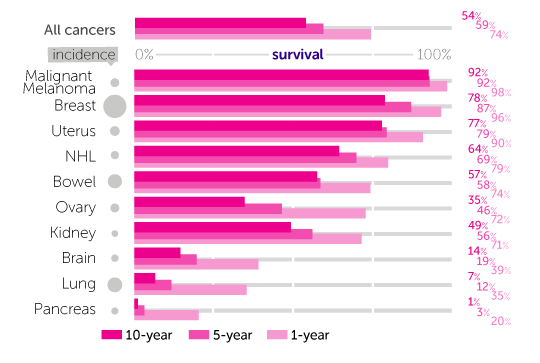
Following on the first part (see here) where the origins of chemotherapy were briefly discussed, I am here today to present the numbers available on the web and that concern survival rates to cancer. This topic is far from being of a simplistic nature; the disease itself is complicated, multifaceted and generates eruptive emotions. But times have been changing with developments made known that bring new pharmaceuticals to hospitals, better knowledge on disease development and more sensitive predictive technology. Available literature on the matter of survival to cancer is not scarce at all, having said that it is difficult to summarise the enormous lists of sources, references and cited researches that populate the Internet these days.

To better present data in a simplified manner, I decided to generate a summary table where you can find the different categories and the sources used to populate it. Bear in mind that, as expected, this is not an exhaustive compilation of data, but a rough approach to some of the most relevant articles I was able to find with the very limited time I have available these days. I hope that this table can, at least, lead you to the very fine research that is being developed by some important research groups worldwide. Apologies if most of these results are retrospective, but as one can imagine the time it takes for these groups to compile genuine data and make sense of the gathered numbers, discuss these and reproduce meaningful information in the shape of reliable publications, is on its own self-explanatory.

Finally, it would be simpler to just copy-paste incredibly well-put information obtained from websites such as the Cancer Research UK (access here) where a comprehensive and extraordinarily well structured summary of cancer survival rates (for most common cancers) is presented concerning the regions of England and Wales. However, this pool of information comes with many limitations, the first one being the fact that not all countries are represented, and the disease specificity as well as the medical techniques involved are not so well described.

[A]


So to overcome this over generalisation that can be informative to a certain extent, but may lack on a certain identity, I decided to approach this article with a live-table. This table is not amorphous or rigid but a 'tool' that I will be updating whenever I find specific articles that due to their inherent quality and development of a particular treatment analysis represent, in my humble opinion, a good retrospective-or-present indicator of the survival rates associated to a certain population/technique/cancer type/methodology. In addition, this is a nicer method to assess how survival rates have changed through time with the improvements on methodology and technology. And click on the images for better resolution!!!

Please consider this article in constant progression: 


[1] Young, J, L., Ries, L. G., Silverberg, E. et al (1986). "Cancer Incidence, Survival and Mortality for Children Younger than Age 15 Years old". Cancer, 58, pp. 598-602.

[2] Lai, E. C., Tompkins, R. K., Mann, L. L., Roslyn, J. J. (1987). "Proximal Bile Duct Cancer. Quality of Survival". Annals of Surgery, 205(2), pp. 111-118.

[3] Folkesson, J., Birgisson, H., Pahlman, L. et al (2005). "Swedish Rectal Cancer Trial: Long lasting benefits from radiotherapy on survival and local recurrence rate". Journal of Clinical Oncology, 23(24), pp. 5644-5650.

[A] Images kindly taken from Cancer Research UK, Cancer survival for common cancers, [http://www.cancerresearchuk.org/health-professional/cancer-statistics/survival/common-cancers-compared#heading-Two], last visited on the 6th of June 2018, last update unknown.


Wednesday, 23 May 2018

The real survival rates to cancer - Part 1 of 3

It is very difficult for anyone detached from the reality of clinical trials and the research developed by the biggest pharmaceutical companies to have access to secretive data pharmaceutical companies hold on their pipeline products (even when they become fully marketed ones).  We don't necessarily have to initiate or feed any kind of global conspiracy theory. There is huge investment in researching a pharmaceutical product destined to battle diseases as serious as cancer is. Such investment must be claimed back when the product reaches the market and becomes fully or partly available to hospitals, patients, for compassionate use, etc. Not always the different governments support pharmaceutical research to the same extent as governments claim taxation on these companies or impose price cuts/subsidiary support when the products are given market authorisation. 

It is not my job to analyse the soul of said companies as it is not my job to scrutinise the role of governments in the market authorisation and governmental participation process. But for such a global, relevant and recurrent disease that is ever so present in our day-to-day lives (every single one of us has to some extent come across a friend/relative/acquaintance affected by its ramifications) the BIG C is an obscure scenario. Whenever we are forced to bereave upon such frailty, our human side becomes a lot more mechanical, I suppose; a lot more statistical. The positive ones will hold onto the minimum numbers and foresee survival, the negative ones will probably see the opposite side of the mirror. I'm not here to judge, but I tend to be a positive one, and I would want everybody to be positive on their experience with such terrifying disease.

Hence, the idea of "celebrating" about 75 years of the first use of chemotherapy agents in a cancer patient [1] made perfect sense to me. A celebration based on survival, on the numbers that we are to increase but still attribute hope, regardless of how small they can be. 

We are then obliged to mention JD, as he was known back at the Yale Medical Center in 1941 when he was diagnosed with lymphosarcoma (a cancer of lymphocites). The expected treatment would be a combination of radiation and surgical resection. A fast-spreading disease branched through JD's body and the cervical tumours he had been screened for suddenly were unresponsive to radiation and spread to his armpit. His fate was about to be drawn if it wasn't for WWI's nitrogen mustard gas and its associated leukopenia (reduction of white blood cells - leukocytes - in the blood) inducing a low count on those exposed to it.


Well cancer, in very basic terms, isn't but a fast and abnormal multiplication of cells. Therefore, any substance that could attack those sub-systems prone to quick cellular production (hair, immune system, etc) could represent a potential pharmaceutical agent if shown to have reduced toxicity against humans. That wasn't the case for mustard gas, but at least the motto for what would become a very interesting research phase was given the go-ahead flag. And nowadays the common plebeian response to cancer is an immediate word -  chemotherapy. However, statistics are still quite hidden beneath the veil of frailty and business approach that both people (affected by their dramas) and pharmaceutical companies (profiting from the human drama) tend to either ignore, restrict, keep or cherry-pick.

***
I decided that for this post I'd refer only 1 article, the one by Panos Christakis (see below). The reason being the fact that it is a great article that can do wonders for your need for historical feed on how chemotherapy emerged from the shadows of Word War I. How life typically emerges from death and vice-versa, in a strange synergy of an uninterrupted circle. As if life and death weren't; and all we have is a continuum. The referred article deserves your uttermost attention as I believe it to be a great piece of work that instruct us on the chronological process of bringing a clinical and pharmacological product/procedure to life from the unexpected.

Before I leave you today with the premise to what is to be expected with the upcoming two additional posts - namely, the numbers on cancer survival rates (scientifically published), I'd like to share with you an additional motto for me to produce this trilogy of posts. It has to do with my past experience as an interpreter working in the NHS when I came across a cancer patient for the first time. No personal details will obviously be mentioned, but on the next post I will open with this extremely intense experience I lived and how it affected me tremendously... emotionally... and spiritually.

[1] Christakis, P. (2011). "The Birth of Chemotherapy at Yale". Yale Journal of Biology and Medicine, 84(2), pp. 169-172.

1st image kindly taken from The Irish Times [https://www.irishtimes.com/life-and-style/health-family/happy-birthday-75-years-of-chemotherapy-is-worth-celebrating-1.3200991].

2nd image kindly taken from Haiku Deck [https://www.haikudeck.com/history-of-wwi-uncategorized-presentation-546htuF1RC].

Monday, 13 June 2011

Lecture 2 - Identifying drugs and pesticides

Approximately a month ago I started a new label here in The Toxicologist Today regarding Analytical Toxicology. The first lecture offered an overview on current Analytical Toxicology methodology, and the second one will very briefly work the subject of analysing drugs and pesticides. 

What is the most used method in systematic toxicological analysis? In the study of specific substances capillary gas chromatography, usually associated to mass spectrometry (MS) detection, is a commonly applied method in the assay of determined analytes. However, basic gas chromatography, HPLC (again supported by MS) are used to analyse certain individual compounds or even groups of analytes. Two other techniques, the first called Diode Array Detector (see video below - it was chosen randomly as I am not paid for advertising) and the second called wavelenght rationing (don't know what it is exactly but will try to find it for a future post) can and are also applied in modern analytical toxicology.


What is important to consider when screening for unknown substances? There are three key steps when adopting systematic analytical toxicology procedures. They are based on three main groups of methods: a) Sample preparation, b) Differentiation and Detection, c) Identification. 

What is the goal of each objective? The aim of sample preparation (for example, homogenization and hydrolysis) is to retain all the important substances  and at the same time remove from the sample matrix those interfering components that can affect your results. Differentiation and Detection (for example, GC and MS) account for the identification of relevant compounds in the minimum timespan possible, whereas Identification is the final step consisting in comparing results obtained with information from available authentic compounds or from available reference databases.

TIP: In order to enhance the quality observation of analytes, a sample may be treated with beta-glucoronidase (an enzyme that breaks down complex carbohydrates) or even arylsulfatase (an enzyme that hydrolyses conjugated metabolites).

That's it for today, I hope you all enjoyed the lecture. I sure did as I revised previously learned concepts, I refreshed experimented methodology and got to know what is going on in the market in terms of lab material/equipment. See you son for a recycling experience here in The Toxicologist Today.

Saturday, 14 May 2011

Lecture 1 - Overview on Analytical Toxicology

A few days back I was just browsing through my books when I found a recent purchase I made around 2 years ago. Well, recent or not, it is up to you to criticise it, but the reason I am bringing it to the blog is because I believe it would be a great idea to just start a series of lectures on Analytical Toxicology. There's loads of people who would like to know how calculations can be made, how certain concepts are defined by the art, what do industries/laboratories have to give us in terms of practical toxicology, in terms of methodology, and empirical curiosities that might generate interest in this amazing science branch. 

It is universal that no knowledge is wasted knowledge, and I want to share this passion of mine with the most of whoever gets to surf this blog. Above all, what I want to avoid is the boring bits that immediately put people of, and go straight to action, therefore any comments are more than welcome and will be definitely appreciated and taken in account

So, for starters, today I have for you A Very Very Brief Overview on Analytical Toxicology:

What is Analytical Toxicology? Analytical Toxicology concerns detection, identification and measuring of drugs as well as other foreign compounds (known as xenobiotics) and their biological metabolites in  subject specimens.

What are the most powerful analytical methods in modern analytical toxicology? Definitely the chromatographic methods in the first place, and right after the ligand immunoassays, but there are several other techniques available. It is important to state, though, that it is virtually impossible to screen for all the toxins/toxicants in the studied samples. The practical trick is to have a clear objective in mind and aim for it.

What are the principle methods and corresponding techniques for the analysis of drugs and organic poisons in biological samples? There are several methods and it would take me ages to list all the possibilities, therefore, I will only discuss the commonest ones. The most applied principles can be divided in seven main categories, thus: 1) in the chromatographic principle one can find gas chromatography (GC), high performance liquid chromatography (HPLC); 2) in the spectrometric principle one can find mass spectrometry (MS), nuclear magnetic resonance (NMR) and spectrophotofluorimetry (SPFM) and ultraviolet/visible absorption spectrophotometry (SPFM); 3) in the electrophoretric principle one can find capillary electrophoresis (CE), capillary electro-chromatography (CEC); 4) in the immunoassay principle  one can find enzyme linked immunosorbent assay (ELISA), radioimmunoassay (RIA), microparticle enzyme immunoassay (MEIA); 5) in the chemical principle one can find the colour test; 6) in the electrochemical principle one can find biosensors and differential pulse polarography (DPP); 7) in the enzyme-based assay one can find alcohol dehydrogenase and aryl acylamide amidohydrolase, ethanol and paracetamol, respectively.

In due time I will present videos and other interactive material offering a much clearer perspective of all these techniques. For now this is it; as in science it is not difficult to confuse entice with boredom if one just overloads the visitor with a paraphernalia of ideas that can, ultimately, undermine the primordial objective. 

See you as soon as possible for a recycling report, once again as usual, on The Toxicologist Today!

Image taken from GenInv - Health and Wellness, http://www.geninv.net/tag/bharat-book-bureau-tel/, last visited on the 14th of May 2011, last update unknown.